The Respiratory System
Main Information and Parts of the System
Jarrett Pelton
Structures:
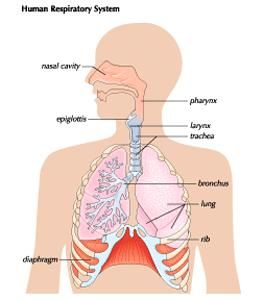
• Sinuses- Hollow spaces in head that are used to regulate the temperature and humidity of air breathed in.
• Nose- The best entrance for air to get into the respiratory system.
• Mouth- Another entrance for air to enter the respiratory system.
• Throat- Collects the air that was taken in by mouth and nose and directs it toward the windpipe.
• Windpipe- The passageway that leads from the throat to the lungs.
• Bronchial Tubes- Tubes that divide the windpipe to go to each lung.
• Lungs- Main organ in the respiratory system that transfers the oxygen to blood capillaries and take in carbon dioxide to be excreted.
• Lobes- The different sections of the lungs.
• Pleura-The two membranes that separate the lungs from the chest wall
• Cilia- Small hairs that wave to move mucus.
• Mucus-Sticky liquid that catches dust, germs, and other unwanted things in the lungs and is gotten rid of.
• Bronchioles- The smallest subdivisions of the Bronchial Tubes that supply air for the Alveoli.
• Alveoli- Small air sacs that are the destination of air breathed in.
• Capillaries- Blood Vessels that are embedded in the walls of the Alveoli.
• Diaphragm- Strong wall of muscle that creates suction by moving down to pull in air and expand the lungs.
• Ribs- Bones that support and protect the chest cavity.
• Sinuses- Hollow spaces in head that are used to regulate the temperature and humidity of air breathed in.
• Nose- The best entrance for air to get into the respiratory system.
• Mouth- Another entrance for air to enter the respiratory system.
• Throat- Collects the air that was taken in by mouth and nose and directs it toward the windpipe.
• Windpipe- The passageway that leads from the throat to the lungs.
• Bronchial Tubes- Tubes that divide the windpipe to go to each lung.
• Lungs- Main organ in the respiratory system that transfers the oxygen to blood capillaries and take in carbon dioxide to be excreted.
• Lobes- The different sections of the lungs.
• Pleura-The two membranes that separate the lungs from the chest wall
• Cilia- Small hairs that wave to move mucus.
• Mucus-Sticky liquid that catches dust, germs, and other unwanted things in the lungs and is gotten rid of.
• Bronchioles- The smallest subdivisions of the Bronchial Tubes that supply air for the Alveoli.
• Alveoli- Small air sacs that are the destination of air breathed in.
• Capillaries- Blood Vessels that are embedded in the walls of the Alveoli.
• Diaphragm- Strong wall of muscle that creates suction by moving down to pull in air and expand the lungs.
• Ribs- Bones that support and protect the chest cavity.
Life Functions:
• Respiration- Breathing to get oxygen for cells to release chemical energy and get rid of carbon dioxide.
• Excretion- Eliminating waste products from the body. It removes carbon dioxide, which is a waste, from the body.
• Regulation- The adaption of an organism to changed conditions. It brings in the oxygen and removes the carbon dioxide necessary to maintain homeostasis.
• Respiration- Breathing to get oxygen for cells to release chemical energy and get rid of carbon dioxide.
• Excretion- Eliminating waste products from the body. It removes carbon dioxide, which is a waste, from the body.
• Regulation- The adaption of an organism to changed conditions. It brings in the oxygen and removes the carbon dioxide necessary to maintain homeostasis.
Maintain Homeostasis:
The respiratory system maintains homeostasis by bringing in oxygen, which is necessary for a human to survive, and it gets rid of carbon dioxide, which would kill a human if not taken out of the body.
The respiratory system maintains homeostasis by bringing in oxygen, which is necessary for a human to survive, and it gets rid of carbon dioxide, which would kill a human if not taken out of the body.
Relationship with Other Body Systems:
• It relates to the excretory system because both of the two excrete or remove wastes. The respiratory system excretes carbon dioxide.
• It relates to the circulatory system because the circulatory system brings the oxygen from the respiratory system to cells.
• It relates to the excretory system because both of the two excrete or remove wastes. The respiratory system excretes carbon dioxide.
• It relates to the circulatory system because the circulatory system brings the oxygen from the respiratory system to cells.